
-
Call Us Now: +852-590-555-89

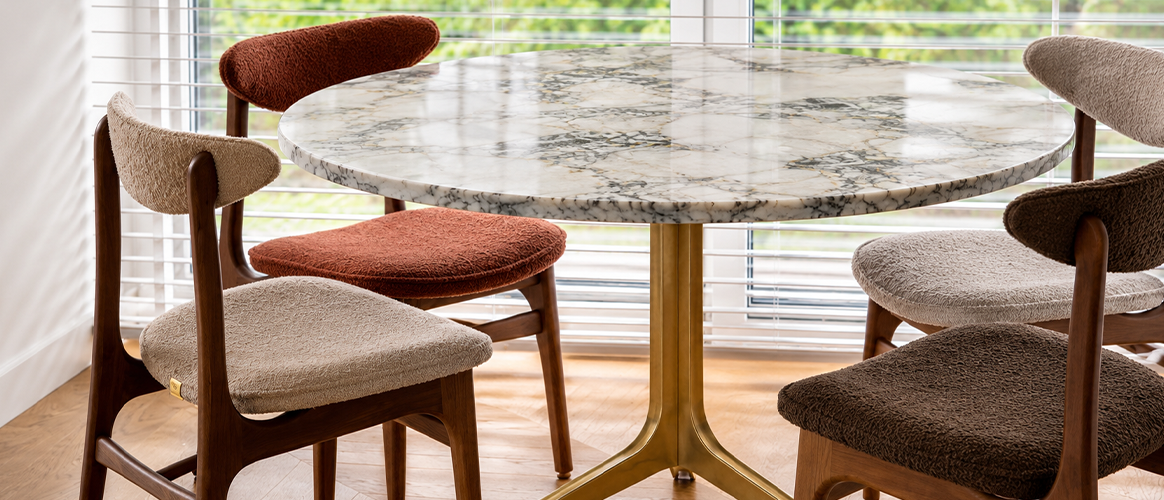
Your dining table doesn’t need to whisper politely from the corner. With the right styling, a marble table can command the room before dinner even arrives. Its veining already brings movement, but lighting, seating, color, and texture decide whether that beauty feels dramatic or merely expensive. The exciting part is that transformation doesn’t require a complete decorating overhaul. A few deliberate choices can turn an overlooked dining area into the setting everyone notices, photographs, and remembers. These design hacks will help you frame the stone, build atmosphere, and make every meal feel worthy of attention today too.
Before buying chairs, lighting, rugs, or decorative objects, study the marble itself. Its color and veining already provide a visual blueprint of the room. Warm cream stone with brown lines may pair naturally with timber, woven textures, and earthy shades. Gray marble can support black metal, smoky glass, muted upholstery. Green stone often works beautifully with warm neutrals and aged metallic finishes.
Avoid forcing the surface into a decorative scheme that ignores its natural personality. Instead, identify two or three colors within the slab and repeat them elsewhere. This creates visual continuity without making every object match.
The marble should feel like the beginning of the story, not an unrelated purchase placed inside an already completed room. When surrounding choices respond to the stone, the entire dining area appears more intentional.
A marble table become memorable when the materials around it tend to create contrast. If every surface is smooth, pale, and reflective, the room may feel flat despite having attractive furniture.
Pair glossy marble with textured dining chairs, a woven rug, linen curtains, or timber cabinetry. Against dark stone, pale upholstery can create a crisp outline. A white or cream table become more striking when surrounded by charcoal, rust, forest green, or deep blue seating.
Contrast can also come through shape. A rectangular slab looks softer beside rounded chairs. A circular table gains structure from chairs with straight backs and defined frames. These differences help each element remain visible while still belonging to the same setting.
Think of contrast as visual seasoning. You need enough to create energy, but not so much that every object competes for attention.
Dining chairs should support the table visually rather than block it. Heavy chairs placed around a thick marble surface can make the entire arrangement feel crowded. Slender frames, open backs, and curved silhouettes often allow the stone to remain visible.
Color can either blend or create separation. Neutral chairs let expressive veining stay prominent. Dark chairs give pale marble a stronger outline, while colorful upholstery can pull a quieter stone into a livelier decorating scheme.
Comfort still matters. A beautiful dining area loses its appeal when guests begin shifting after twenty minutes. Look at sit depth, back support, fabric texture, and the distance between the chair and table edge.
Check how the chairs appear when pushed in as well as pulled out. Since they spend much of the day tucked beneath the surface, their scale and positioning directly influence how open or crowded the table looks.
Overhead lighting acts like a spotlight for the dining table. If the fixture hangs too high, it may feel disconnected from the furniture. If it sits too low, it can interrupt conversation and block views across the room.
Choose a fixture that relates to the table’s shape. A long pendant or linear arrangement suits a rectangular design. A round chandelier, globe, or clustered fixture can echo a circular table. For an oval surface, softly curved lighting creates an appealing visual rhythm.
Warm illumination helps marble feel inviting, especially when the stone contains gray or white tones, Diffused light also reduces sharp reflections on polished surfaces.
Place the fixture so it visually belongs to the dining arrangement. The aim is to create a defined pool of light that makes the table feel like the room’s natural gathering point.
A dining rug does more than soften the floor. It creates a visual boundary around the table and makes the entire arrangement feel like one complete composition.
Choose a rug large enough to hold every chair, even when guests pull them backward. A rug that ends beneath the chair legs can make movement awkward and cause the dining zone to appear undersized.
Patterns depend on the marble. Strong veining usually works well with a quieter rug, while subtle stone can handle bolder geometry or color. Flat-woven and low-pile styles allow chairs to move more easily than thick, plush options.
Use the rug to introduce warmth, especially when the room contains tile, metal, glass, or other hard materials. It becomes the visual stage beneath the stone, helping the table anchored instead of floating in open space.
The centerpiece should attract the eye without hiding the marble or interrupting conversation. Oversized arrangements may look impressive from the doorway, but they can become frustrating once people sit down.
A low sculptural bowl, a group of candleholders, or a compact floral arrangement can add interest while preserving clear sight-lines. Consider grouping objects in odd numbers, such as three vessels with varied heights. This tends to create movement without filling every available inch.
The centerpiece also reflect the season through flowers, fruit, branches, or colored candles. However, frequent changes are not essential. A single object with an interesting shape may create a stronger statement than several unrelated decorations.
Leave enough open surface for the veining to remain visible. Marble already provides pattern, so decoration should frame its character rather than cover the feature you wanted everyone to notice.
Matching furniture sets can make decorating straightforward, but they may also remove the tension that gives a room personality. A marble table becomes more expressive when nearby shapes interact rather than repeat one another exactly.
Place curved chairs around a rectangular table to soften its edges. Pair a round marble surface with a geometric pendant for contrast. Use an oval mirror or arched network behind a square dining arrangement to introduce movement across the wall.
Repeating one shape selectively can still create cohesion. A circular table, rounded vase, and globe light may form a visual thread, provided other elements add enough variation.
The objective is not randomness. Each form should create a relationship with the table. When curves, lines, and angles tend to communicate across the room, the dining area feels layered rather than purchased as a single predictable package.
The wall nearest the dining table can strengthen the entire arrangement. Leaving it blank work in a highly restrained space, but many rooms benefit from a supporting visual feature.
Large artwork can echo colors from the stone and draw attention toward the dining zone. A mirror reflects light and allows the marble to appear from another angle. Textured wall finishes, narrow shelving, or subtle paneling can create depth without stealing focus.
Scale matters here. Tiny artwork above a substantial table may appear disconnected, while an oversized piece can overwhelm the furniture. Aim for a relationship that feels balanced from both seated and standing viewpoints.
Avoid filling the wall simply because it is empty. Choose an idea with enough presence to support the table. The goal is to create a backdrop that frames the dining area like a composed scene.
A dining table should look inviting even when no formal meal is planned. Everyday styling gives the room a sense of activity while keeping the marble visible.
Try placing a broad bowl near the center with seasonal fruit, textured objects, or simple branches. A tray can organize candles, napkins, or small vessels while making the arrangement easy to move at mealtime. A folded runner can introduce fabric without covering the entire surface.
Resist turning the table into storage for mail, cables, shopping bags, and unused dishes. Once clutter takes over, the stone disappears and the room loses its focal point.
Create another designated place for household items that tend to land on the dining surface. Keeping the table visually open encourages people to use it for conversation, meals, gatherings rather than as an oversized shelf.
Making a marble dining table the star of the room is not about surrounding it with constant drama. It is giving the stone enough visual support, contrast, and breathing room to show its character.
Study the veining before selecting colors. Use chairs to frame the surface, lighting to define it, and a rug to anchor it. Add texture so the room feels inviting, then keep decorations enough for conversation. Every decision should guide attention back toward the table without making the setting feel forced.
A marble table already arrives with movement, depth, and personality written to its surface. Your role is simply to reveal those qualities. Style it with confidence, use it often, and let ordinary meals become part of the show.